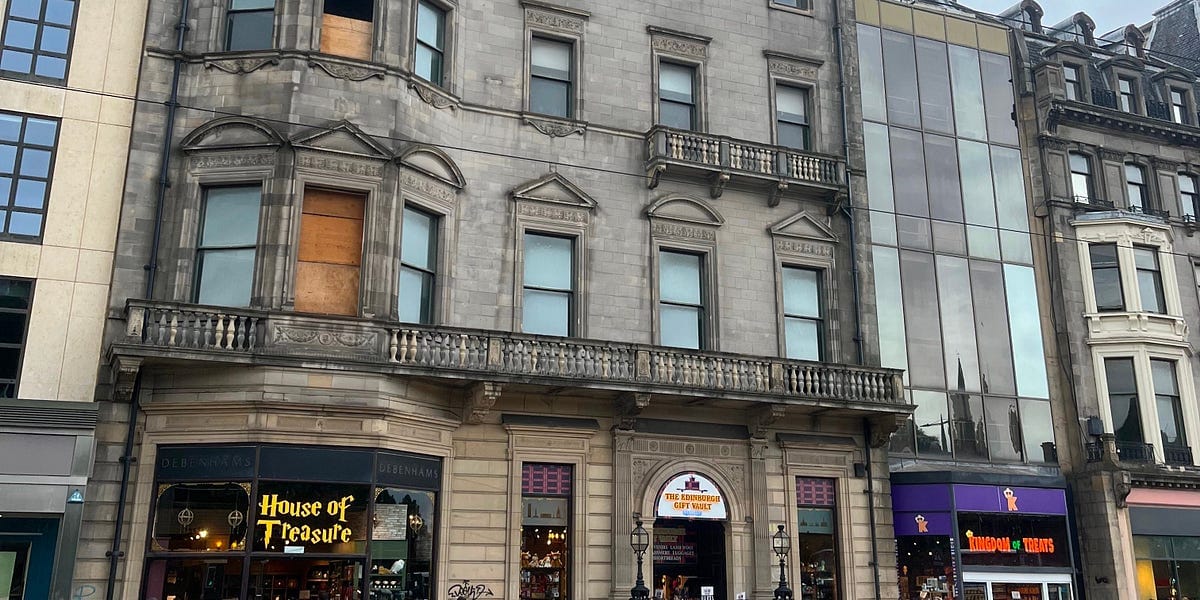
Investigation: Finding the Princes Street fire shop owner
An update on who was running the tax-evading gift shops during the the Princes Street fire


Today, in collaboration with London Centric, we’ve been trying to track down who was operating a series of gift shops in the former Debenhams store on Princes Street when it burned down last month. In the process we uncovered her connection to a London Leicester Square gift shop, rented from the same landlord, which collapsed without paying its taxes and left a council out of pocket.
By Jim Waterson and Polly Smythe
The former Debenhams, owned by London landlord Criterion Capital, burned down last month. It had been due to be converted into one of Criterion’s windowless Zedwell hotels. Police and firefighters are continuing to investigate the cause of the fire.
Prior to the fire, London Centric and the Edinburgh Minute had already revealed how this building was being occupied by a series of tax-evading gift shops run by a rotating cast of Londoners living in squalid shared accommodation, from Hoxton to Uxbridge.
We showed the businesses genuinely did sell a substantial amount of real souvenirs. They just didn’t pay their taxes.
Every few months a new company would pop up and the shop would “phoenix” overnight to a new legal owner, while looking largely identical to the passer-by.
 Jim Waterson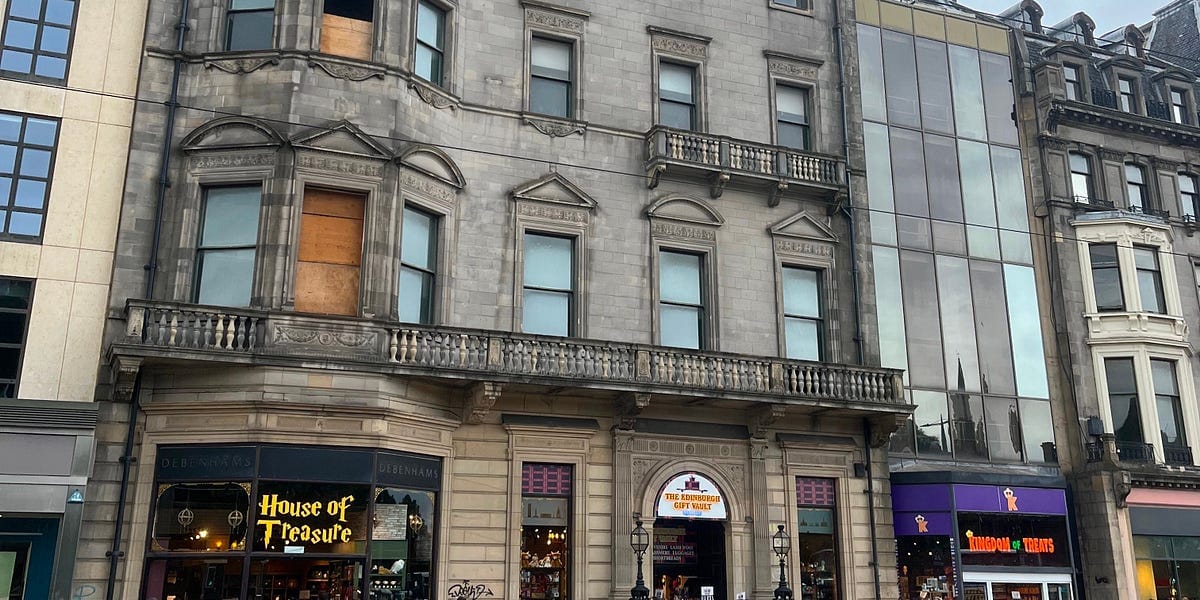
We now know, thanks to the Herald’s Josh Pizzuto-Pomaco, that our reporting may have encouraged the Scottish authorities to raid the Edinburgh building earlier this summer, just before it burned down.
One detail caught our eye about the raids. After spending years staring at the web of business owners involved in the gift shop networks, we spotted a clear London connection.
The raided Edinburgh gift shops were run by a company called Bwn Beverage Ltd. This firm is legally controlled by a 28-year-old Bangladeshi national from Wood Green in north London called Rumi Chowdhury.
We checked our records of dubious shop operators and found that Chowdhury had a history in the London gift shop trade, as she also runs a company called Fort Traders Ltd. It operated a prominent gift shop in Leicester Square next to the Empire Cinema, until it was wound up by the high court this summer for failing to pay its taxes to Westminster Council.
In both London and Edinburgh, Chowdhury’s gift shops rented units from landlord Criterion Capital.
How had Chowdhury ended up in the retail trade and where did she find the money to rent all these gift shop units? Did this young Londoner notice anything notable about the state of the Edinburgh building prior to the fire? How did someone with no clear business record repeatedly secure leases on some of the UK’s most prominent retail units? And why does she keep failing to pay her taxes?
We got on our bike and travelled around London to ask her.
Step one: the house in Wood Green that Chowdhury gave as her personal address.
When we visited Chowdhury’s registered home address in Wood Green, London Centric discovered it was occupied by an unrelated family who said they had never heard of the woman or received any post addressed to her.
Step two: the block in Dagenham where Chowdhury registered her gift shop company headquarters.
When we visited her company’s registered headquarters, in a one-bed council flat in Dagenham, we found nobody was at home in the run-down block.
The same flat had previously been used by other young, unrelated Bangladeshi nationals as the headquarters for a separate tax-evading American Candy Shop called ‘Kingdom of Treats’ based in the Trocadero building at Piccadilly Circus, another Criterion-owned property.
Step three: a house in Leyton previously connected to Chowdhury’s gift shop business.
When we visited a third and final address in Leyton that was previously connected to Chowdhury’s gift shop business, we found a temporary accommodation unit on a quiet residential street used by the council to house vulnerable tenants. The current occupants had never heard of a retail operation that might have been run from their property. We asked if it was possible that anyone came to pick up the post for a gift shop business. They said the only regular visitor was a Polish woman who came to the house every day, as her family had been temporarily housed there and they moved without telling her where they’d gone.
None of the addresses we visited gave the impression of being the base for a major retail business running some gift shops in some of the most prominent locations in the UK.
In previous cases London Centric has repeatedly found that people with limited financial means, often international students who don’t plan to stay in the UK long term, are paid small sums to sign legal paperwork and claim to operate the shops. They then vanish when things go south, leaving behind a load of unenforceable debts. Britain’s wafer-thin checks on the people running companies, which is turning London into a scammer’s paradise due to lack of basic enforcement activity, mean the real operators are never chased down. We don’t know if that’s the case here.
There is also zero suggestion that Criterion Capital has any responsibility for the tax affairs of its tenants. When a landlord leases a shop unit to a company, paying property taxes becomes the tenant’s problem. The landlord’s responsibilities are limited to collecting rent and maintaining the building.
Out of interest and without any implication of wrongdoing, we wanted to know why Criterion Capital had decided to rent prominent retail units in both London and Edinburgh to companies run by a woman with no clear source of funds, who didn’t seem to exist at any of the addresses she provided, and who had a track record of running companies that failed to pay their taxes.
We asked:
- What checks Criterion carried out on Chowdhury before letting shops to her newly-formed companies? Did it verify she existed at the addresses provided?
- Why it rented the Edinburgh shops to her new company, given Criterion had previously had to deal with her Leicester Square gift shop going bust over unpaid taxes?
- Whether Criterion received rent on the shop units, even if the tenant was not paying its taxes?
- Whether Criterion is concerned it is being targeted by an organised group leasing its properties to run tax-evading gift shops, given we have now identified more than twenty such businesses that have operated out of Criterion-owned buildings in the last four years?
The company declined to respond on the record.
That said, Criterion’s lawyers have previously told London Centric they’d be more than happy to help HMRC with any inquiries into the tax affairs of gift shops that occupy any of their buildings.
Edinburgh council leader Jane Meagher said deliberate tax evasion is “fundamentally unfair on the thousands of honest Edinburgh businesses who play by the rules”.
She told London Centric her council needed support from all levels of government: “These rogue businesses are not welcome in our city, and we’ll continue to target and disrupt them using all the enforcement powers at our disposal, alongside working with our partners in government and the police. Clearly though, this is an issue that stretches far beyond Edinburgh, and I raised this with the Deputy First Minister during our meeting yesterday. A concerted effort across local authorities, devolved governments, and the UK Government is needed to properly tackle this.”
We left notes at Chowdhury’s registered addresses, but she did not respond to requests for comment.
London Centric is an award-winning local newsletter. If any Edinburgh Minute readers are interested in reading it then pay it a visit here and consider joining the mailing list. If you are able to support London Centric and want to access its paywalled articles then click here to receive 25% off.
 Jim Waterson